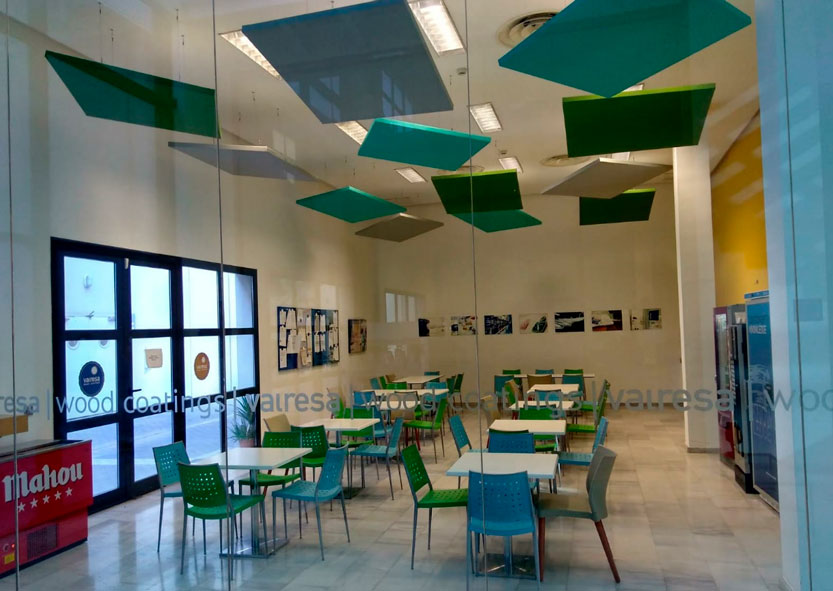
Problem:
Restaurant where noise levels increase with occupancy. When at full capacity, the commotion is considerable and customers complain about lack of privacy.
This problem is due to the architecture and materials of the premises: the restaurant has a large volume, high ceilings, and is composed of many reflective surfaces—large windows that provide natural light to the space and polished flooring—producing sound wave reflections that generate high reverberation.


Objective:
Improve the acoustic comfort of the premises by reducing reverberation, while integrating the solutions into the décor. This not only improves the privacy of diners, but also adds decorative value to the space.
Intervention:
- Step 1 – Diagnosis: By conducting on-site reverberation time tests of the premises—following the international standard UNE-EN ISO 3382-2, established as applicable in the Technical Building Code—and using appropriate measurement instrumentation—Type 1 sound level meter according to IEC 61672.1 standard and omnidirectional sound source to emit pink noise—the reverberation time results of the premises are obtained, providing a diagnosis of the existing reverberation level.
- Step 2 – Solution Design: Since all our acoustic fabrics are tested according to UNE-EN ISO 354 standard, we have the absorption coefficient for each of them. From this parameter and the reverberation time data obtained, we calculate the panel surface area to be installed to reduce reverberation. The placement and orientation of the panels are particularly important for the intervention to be effective—installation is possible on both walls and ceilings. Once solutions are selected based on technical criteria, the decorative design phase begins, where it is possible to combine colors, textures, and prints.
- Step 3 – Installation: corrective measures are installed inside the premises—acoustic panels. The process is quick, allowing the premises to avoid construction work and not interrupt service.
- Step 4 – Verification: measurements of the premises are taken after installing the acoustic solutions to verify their effectiveness—comparing the results with those obtained in the diagnosis.