
What can we do to improve the appearance or durability of a fabric? How can we enhance a fabric? It depends on the fibres it is made of; we will carry out the operations before and after the spinning process in one way or another.
In order to dye, print, or apply finishes to the fabric, it is essential to carry out the so-called “preparation operations”. We must remove impurities and anything that could hinder the application of dyes or finishes.
There are two types of impurities that we can find in fibres: natural ones, which come from the source plant or are produced by the animal, and added ones, which are introduced during the spinning process (gums, oils, etc.).
In plant-based fibres, singeing can be carried out to remove fibres that protrude from the fabric (fuzz) by bringing the fabric close to a flame. We can also desize (remove impurities that we have added to the fabrics) and scour (remove impurities that cannot be dissolved in water). As mentioned in the section on fibres, cotton can be mercerised so that the yarn becomes shinier, dyes better, and the fibres swell, which improves its strength.
In turn, animal-based fibres such as wool or silk need to have grease and waxes removed with detergents and degumming agents before dyeing or weaving.
All fabrics made from natural fibres need to be bleached in order to dye them light colours or white (imagine we want a white or beige jute fabric; we must bleach it first, as the natural colour of jute is brown.
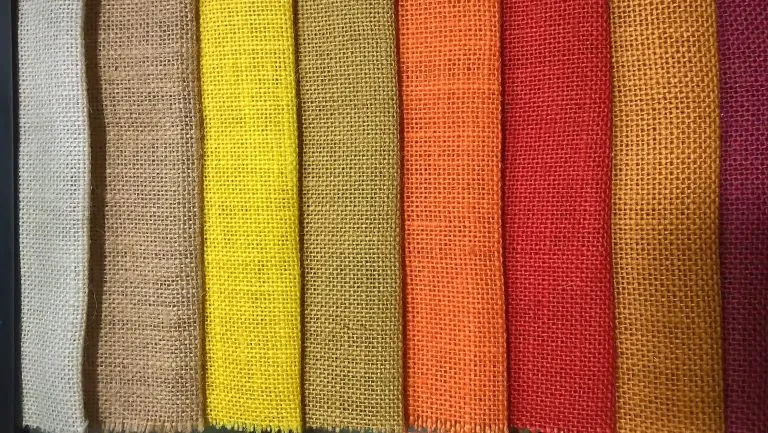
We have all heard of “optical white”, which we can distinguish from “natural white” under ultraviolet light (the former will glow and the latter will not). Optical bleaching aims to improve the degree of whiteness.
An important improvement we can make to textile material is dyeing. We can dye the fibres, the yarn, the fabric, or the finished garment. Two methods are distinguished for this:
Exhaust dyeing
The textile material is brought into contact with the dye until it is exhausted.
Impregnation
A garment is impregnated with dye and then passed through two rollers to squeeze out the excess dye. Finally, the fabric is washed.
Parameters such as pH, speed, temperature, or time influence dyeing. Dyeing depends on these and other parameters, so defects are very common. What are the most common? Lack of uniformity, local stains, light spots…
If we only want localised colouring, instead of dyeing the entire fabric, we use the printing technique.
What steps are required to achieve good printing?
- Prepare the fabric (mercerising, bleaching, degreasing, etc.).
- Prepare the colour paste to be used.
- Prepare the machine and apply the colour.
- Fix the colour (by heat, steaming, or another method).
- Washing and operations according to the printing process.
To print pastes correctly, it is very important that they have the right viscosity; otherwise, the design may not be well defined, or it may seep through the fabric if it is too liquid. This parameter can be measured with a viscometer.
We can print manually (each stencil will be in a frame), by machine (mould, rollers, stencils), or digitally, always printing dark colours before light ones, and glitter, etc.
The main printing systems are as follows:
Direct printing
It consists of applying the paste to the fabric (it is the most widely used).
Discharge printing, colourless or coloured
Discharge dyes are often used to create a design on top of dark fabrics.
Resist
printing
A paste is applied that prevents the penetration of dyes so that, later, the entire fabric can be dyed.
Sublimation or transfer printing
The design is printed on paper, which is then transferred to the fabric (preferably polyester) by applying heat.
Digital
printing
Thanks to printing, we can see textiles with flocking, puff effects, laminations, glitter…
Finally, once we have the fabric washed, bleached, and dyed or printed, we can apply sizes (chemical) and finishes (mechanical).
Mechanical finishes apply heat, pressure, tension, etc., using machines designed for this purpose. Some mechanical finishes are: calendering (tension, temperature, and humidity are applied) to increase shine or for ironing; embossing, in which a design engraved on the cylinder is imprinted by applying pressure and temperature; sanding, which involves abrading the fabric to create a peach-skin effect; or raising, which increases the fabric’s nap.
Chemical finishes or sizes improve a property of the fabric by applying chemical products. Some of the most commonly used sizes are: water-repellent, antibacterial, flame-retardant, fungicidal, UV, or antistatic finishes.