
Label is defined as:
A mark, sign, or tag placed on an object or merchandise for identification, valuation, classification, etc.; that is, any legend, image, or other descriptive or graphic element or sign, written, printed, stamped, marked, engraved, adhered to, or attached to the packaging or on the product itself.
Labeling is defined by:
All information, written, printed, or graphic relating to a product, which must mandatorily accompany it when presented for sale to the consumer.
One of the most important functions of labeling is to identify the party responsible for the product, which may be the manufacturer, distributor, seller, importer, or even the brand owner.
The labeling of a product is its presentation card and also its quality guarantee.
As a general rule, textile products must be properly labeled before being placed on the market. All indications appearing on the label must be clearly visible and easily legible by the consumer, and it is mandatory that they appear at least in the official language of the state of origin.
Composition labeling:
It should be noted that textile products may only be marketed if they are labeled or marked or accompanied by commercial documents in accordance with EU Regulation 1007/2011.
The most common compositions are:
Abbreviation
AR
AS
CA
CO
CV
EA
GL
JU
LI
PA
PE
Fiber
Aramid
Antistatic fiber
Acetate, Rayon Acetate
Cotton
Viscose, Rayon Viscose
Elastane
Glass fiber
Jute
Linen
Polyamide, Nylon
Polyethylene
Abbreviation
PES
PP
PU
PVC
RA
RES
SE
SI
SIL
SILCN
WO
Fiber
Polyester
Polypropylene
Polyurethane
Polyvinyl Chloride
Ramie
Acrylic resin
Silk
Sisal
Silica
Silicone
Wool
Labeling information:
The information that must be present on labels, according to current regulations, is as follows:
- Identification of the manufacturer, trader, distributor, or importer.
- Composition of the article.
On a voluntary basis:
- Care of the article.
- Information regarding parameters of importance for use and maintenance.
- Ecological labels, such as the Oeko-Tex and Made in Green labels, among others.
General labeling regulations:
Regulation No. 1007/2011 of the European Parliament and of the Council of September 27, 2011. This Regulation is binding in its entirety and directly applicable in each Member State. From May 8, 2012.
General specifications
Voluntary indications or information, such as pilling resistance, flame retardant, waterproof, shrink-resistant, care symbols, etc., must appear clearly differentiated.
All mandatory indications must appear in clearly visible characters and easily visible to the consumer.
All indications must appear on the label in the official language of the State.
Placement
of labeling
The label shall be made of any durable material; the labeling and marking of textile products shall be durable.
It shall be legible, visible, and easily accessible.
Mandatory
information
The identification of the party responsible for the garment or textile product: name or business name or designation of the manufacturer, trader, or importer and their address.
The composition of the article: this is the % of the fibers that make up the article.
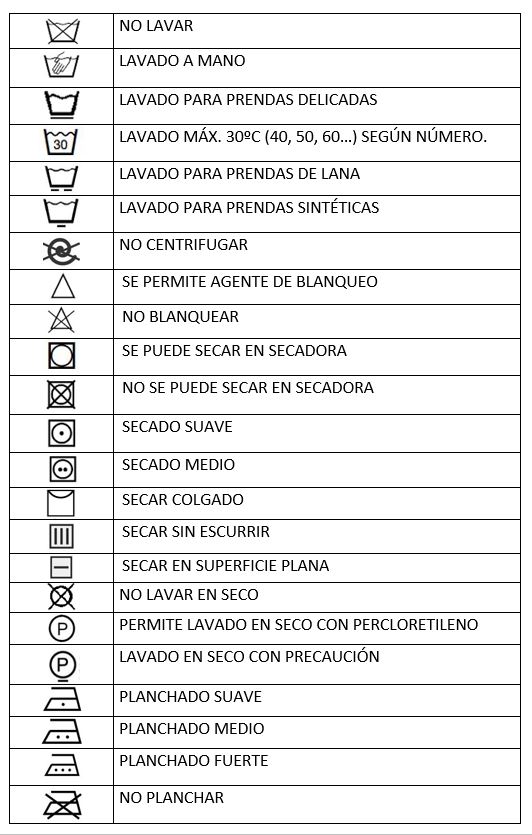
Care:
Care labeling is not mandatory, although it is an increasingly widespread practice. For this reason, depending on the country, the symbols vary.
The ones we are most accustomed to seeing are:
Ecological labeling
Ecological labeling is a distinctive mark intended to identify companies, products, or services that meet certain “environmental friendliness” criteria.
We can find:
OEKO-TEX 100 is a worldwide unified testing and certification system for raw, intermediate, and finished textile products at all processing stages. Based on the analysis of the presence, and in what quantity, of a series of substances harmful to health.
There are currently 15 member institutes. In Spain, AITEX is the authorized laboratory for granting the OEKO-TEX label.